Showing posts with label street food. Show all posts

Friday, September 17, 2010

Street food V: picolé & street café

20 nov. 2009
Picolé!
became one of my favorite words since the first time I heard it. I first saw it on a box like this one:
being held by one of the beach vendors who also sell kangas and jewlery made of brazilian wood, seeds, plants etc. And I was intrigued by just the sound of it: picolé /pee-ko-leh/.
anyway I soon found out that it was a Popsicle like this one.

Exhibit B: the street cafés or carrinhos de cafe


I also was a little confused by them at first because there was just a cart with all these red jugs in it and it didn't say coffee (or at least from the angle I was looking at it). And also because I guess I've just never been used to this idea of selling hot coffee in the summer, in the evening! But I guess, people need it? The cool this is that they don't only sell coffee..ohh nooooo! Every cart besides having some colored thermoses, has it's own personality, different colors, art work. Some are simple

[photo credit Dimitri Ganzelevitch because i was always paranoid about taking pictures out in the street when I wasn't surrounded by like 10 people]
and some go all out with music, umbrellas, couches!
Apparently there is an annual competition/show of these carts to see who has the most accomodating atmosphere and my host mom said that there was one with a couch and a big TV with loud speakers and all this stuff. And like Clara the coordinator or the Big Mama of the group would always say "This could only happen in Bahia, people!" and I believe it.
apparently these little carts started appearing in the 70s and now they're just a part of the busy urban setting. Too bad I don't drink coffee.

Tuesday, April 6, 2010

Crêpe on a stick


10 Nov 2009

Crêpe on a stick!
I'm not sure how common this food is as a street food or otherwise, but it is pretty much what it sounds like
There are these molds and the person pours in a layer of Crêpe batter and then a filling of what you want.

Here there were cheese, cheese and ham, bunless hotdog (I never know the more appropriate word for these), hotdog with cheese, cheese and oregano, salami with cheese, cheese and goiabada, and chocolate. I went with cheese and goiabada :)

then the last layer of the batter is put on top and then voila finnito--oh wait, they put a stick in there somewhere before the "iron" it together.
And as the sign says they're R$2 so about 1 dollar each. :)

[minha irma e eu! my sister y yo --spanglish translation]
Oh right, and they sell these at that jazz jam at the MAM (museum of modern art) in Salvador. They were really good I give them a **** for street food. well may be another * one becuase it also didn't give me a stomach ache, and it was cheese.


Sunday, April 4, 2010

Parque Pituaçú

07 Nov. 2009

Today we set out for the Parque Metropolitano de Pituaçú!
Again we took a bus the big yellow the one that ends up going to Praia do Flamengo. It was about 1 hour and if i'm not mistaken is somewhere nearish Pituba (in Salvador, BA).
And as we were walking a long the beach to cross the road, we ran into Lean's pai! Her host dad was out ...churrascando? making churrascos. Well, Brazilian barbecuing with his friends and family. He apparently does this almost every weekend.
The churrasco is the method of barbecue of putting the meat on a stick and then putting it in a fire oven.

Of course he offered some to us, so we snacked a bit. I must say this family had some of the best sausage ever! I've eaten a few times at Lean's house and I have to say I like their meat better. :)
So we stayed
The entrance of the park.


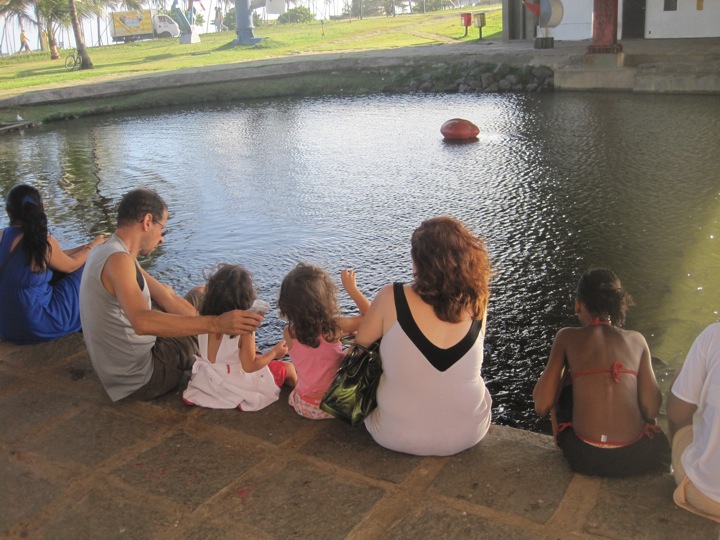
These people were feeding some fish that were in this pond and there was a lady selling little bags of food to give to the fish.

Oh yeah the reason we were there was that we had plans for some party like a late halloween party but it was cancelled and I'm like 'what should we do?' That's when I went over to Algebra's house and...I think i ate there again :) so sneaky. But we decided to go to a park, and there was one on the tourist map that Clara the coordinator gave us on the first day that had little bicycle figures on it so we decided, it was meant to be! And we got together with another friend of ours who was in town.
When we got to the park, we had gotten there too late to go to the park by then, so it was actually not meant to be. :(
But...

Then we saw there were swan boats! And my friend and I decided to go together. Just me and her in a swan boat, on a pond, surrounded by tropical forest, as the sun was setting.--it was ridiculously romantic. I mean once Algebra finally managed to get the boat out of dock hahaha. Oh I we teased her about that. She actually somehow turned the swan boat around as soon as we were given a push off and crashed into the dock, then we finally got into reverse a little and then we crashed into other swan boats--which were parked. It was great. I'm really glad I let her drive because she has a license.

This seems to be quite a popular park. There are so many children in certain areas. And here some more street food, popcorn is a super common street food around here. May be important for you to know it's called "pipoca"
horsey. I'm not sure why this horse was here, it was a lone, I mean this park is not a horse ranch, but here it is. WEll I'm not going to complain.

Tuesday, March 30, 2010

Molho de Cana (sugar cane juice)

This is a stand on the street offering what you see on the paper: água de côco, and some other things but also freshly pressed as the vendor is doing now--sugar cane juice.

oh my family bought me a whole cup all to my self. It turned out to be too much for me because as you can imagine it was super sweet. So I saved half of it in the fridge,
but a tip: sugar cane juice is 300% better fresh than even 20 minutes old, so drink up or I also encourage sharing!
It was pretty cheap but I do recommend caution. My friend's mãe who is a researcher in plants and biology said to not drink this because there is some parasite that is found in a lot of these cane stalks, but nothing happened to me, so it's just a risk.
Remember whatever you get, foodwise especially be cautious and check it out well before ingesting it. :) thank you

Thursday, March 25, 2010

Street food IV: Queijo Assado

26. 09. 2009
Queijo Assado means roasted cheese I guess. But it seems to be a common street food on the beach. you see people walking around with a big clear plastic container filled with cheese rectangles. And when people buy them they roast them on the spot with a little tin with a little fire and ashes and it really does work. Then you can have it flavored. I tried one with oregano flakes and it integrates well into the slighly melted cheese. It was really delicious but use your judgement as to whether you should have some. You should generally be cautious about food--especially if you have IBS and are lactose intolerant like me--but I had no problems when I ate some. :)
[Picture credit: Anabel Mascarenhas]

I took this picture at the JAM no MAM which is a jazz jam at the Museo de arte moderna (Museum of Modern Art) in Salvador. you can see that plastic container I was talking about and the pre-roasted cheese on a stick, and the lady grilling it.

Wednesday, March 24, 2010

Street Food III: Cachorro quente e hamburguer

O Cachorro Quente e o Hambúrguer (The hot dog and the hamburger)

I don't think you need pictures of these. But it is a very common street food in Salvador. there is a hamburger stand right outside a public high school on my way to ACBEU. It's right on the sidewalk. But it's different. They have a little bench and a TV so it doesn't have to be street food to go, you can stay on that singular bench and watch some cartoons or movies. I've actually seen that in Mexico too.

Footnote: Cachorros Quentes and Hambúrguers are not a traditional Brazilian food. Just to not confuse anyone, just in case.

Wednesday, March 17, 2010

Street Food II, acarajé & abará

11 Oct 2009
ACARAJÉ

Acarajé is one of the MOST traditional Bahian anything. It's an icon and so are the women who traditionally make them. They are called "Baianas" :). They are usually dressed in all white big skirts, shirts and a head scarf. Like most current Brazil is influenced by the history of colonization and slavery, so does the making of acarajé.
When Brazil was going through the exruciatingly slow process of emancipation of slavery, (it took centuries!) there were some free Black people who were either free because of the "Free womb" law, or because they paid their "masters" a satisfactory amount. This was one of the things that people did to earn money. Women were sometimes sent out to sell fruits on the streets for their masters who would receive most of the profit but sometimes they kept a little bit for themselves. Or there would be these groups juntos that were made up of several slaves and freed and they would all pitch in to buy people's freedom one by one but this way it was much faster than each individual waiting to accumulate enough money.

Then when slavery was abolished, there was no assistance from the government at all for all of these now unemployed people who now had to face racism. However many women, who came to be called ganhadeiras, found out ways to enter the business arena and it was usually by selling their products, sometimes fruits, and food like Acarajé, which is actually traditionally from Nigeria, and Ghana, Africa. It is still found in those countries and prepared almost exactly the same.
These ganhadeiras were actually where hollywood and industries got their ideas about the fruit hats. Because the ganhadeiras would carry the basket of the fruits they were selling on top of their heads.
This was the inspiration for Carmen Miranda:

Very interesting that this Portuguese-born White woman became the face for not only Brazil but all of South/Latin America.
And Chiquita Banana followed suit:
So after the little history lesson this is Acarajé


A video on how it's made. There is a black eyed peas or beans made into a paste with ground dried shrimp and then it is fried in dendê (palm) oil which is very flavorful in itself. Then it is usually cut open and stuffed with tomatoes, shrimp, vatapá and carurú, which I've described before and are pictured below:
http://soniabrazilmorethanahottouristspot.blogspot.com/2009/12/caruru.html

They work into the night too.

ABARÁ

This one is the exact same thing except it is not fried, but wrapped in banana leaf and steamed much like tamales.


(This picture just shows a better view of the condiments)

I personally think that fried one is better, but abara is probably more healthful. But they're both worth trying if you're in Bahia or Rio de Janeiro.